When people compare office chairs, they usually look at the seat, backrest, lumbar support, and armrests first. The base rarely gets the same attention. That is understandable because you spend most of your time sitting above it, not looking at it. But the base is one of the parts carrying your weight every minute you are in the chair.
The five-star base supports the casters and gas cylinder, while the internal frame provides the structure underneath the seat and backrest. A well-built chair should feel stable when you sit down, move around, or lean back. A poorly made base or frame can eventually flex, develop damage, or make the chair feel less secure.
Quick answer
Reinforced nylon is a practical choice for most everyday office chairs because it can be strong, durable, and relatively light. Steel and aluminium offer a more rigid, premium construction and can make sense for heavy-duty or higher-end chairs. The material alone is not enough, though — construction quality, weight capacity, design, and warranty all matter.

What does the office chair base actually do?
The base is the five-legged structure underneath the chair. Each leg extends from the centre and normally ends in a caster. The gas cylinder fits into the centre of the base and connects the lower part of the chair to the seat mechanism.
Its main job is stability. When you sit normally, your weight is concentrated around the centre of the chair. When you lean, reach for something, roll backwards, or shift your position, the load changes. The wide five-star footprint gives the chair a stable platform for those movements.
The base also has to cope with repeated loading rather than just your body weight at one moment. An office chair may be sat on and moved thousands of times during its useful life, so material quality and construction are important for long-term reliability.
Why are five-star bases so common?
Most modern rolling office chairs use five-star bases because five evenly distributed legs provide a useful combination of stability and mobility. The casters are spread around the chair rather than concentrated close to the centre, giving the chair a wider footprint.
The important point is not simply the number five. The spacing, geometry, material, caster connection, and overall construction also affect how stable the chair feels. A five-star base made from a weak material is not automatically a high-quality base.
A simple buying rule
Don't judge a chair's base only by whether it is labelled "metal" or "nylon." Look at the complete construction, the manufacturer's weight rating, warranty, and whether replacement parts are available.
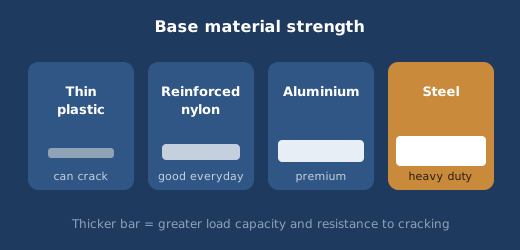
Office chair base materials compared
1. Basic plastic
Basic moulded plastic is commonly used on inexpensive chairs because it keeps manufacturing costs down. Plastic itself is not automatically bad, but a thin or poorly reinforced base has less margin for heavy or repeated loading.
The areas around the centre cylinder socket and caster connections deserve particular attention because they carry concentrated loads. If a plastic base develops a visible crack, significant deformation, or unusual movement, continuing to use the chair is not worth the risk.
2. Reinforced nylon
Reinforced nylon is different from the thin plastic found on some budget chairs. It can be strengthened with glass fibre and designed specifically for the loads encountered in an office chair.
One advantage is weight. A reinforced nylon base can provide substantial strength without the mass of a steel base. This makes it a practical choice for many everyday office chairs where you want a durable base without paying for a premium metal construction.
If a chair uses reinforced nylon, it is still worth checking the manufacturer's stated weight capacity rather than assuming that every nylon base has the same strength.
3. Aluminium
Aluminium bases are common on more premium chairs. They can provide a rigid structure while remaining lighter than steel, and polished or coated aluminium can also give a chair a distinctive appearance.
The main reason to choose aluminium should not be appearance alone. A well-designed aluminium base can be a long-lasting structural component, particularly when the rest of the chair is built to a similar standard.
4. Steel
Steel is known for its strength and rigidity. A steel base can feel extremely solid and is suitable for chairs designed around heavier-duty use.
The trade-off is weight. Steel is generally heavier than nylon and aluminium, which can make the chair less convenient to move. For a stationary workstation this may not matter much, but it is something to consider if you regularly move the chair between rooms.
| Material | Strength potential | Weight | Typical use |
|---|---|---|---|
| Basic plastic | Varies; lower-quality versions can flex | Light | Budget chairs |
| Reinforced nylon | Good | Light | Everyday and mid-range chairs |
| Aluminium | High | Moderate | Premium chairs |
| Steel | Very high | Heavy | Heavy-duty and premium chairs |
Nylon vs metal: which should you choose?
There isn't one material that is automatically best for every chair. A properly engineered reinforced nylon base can be completely adequate for everyday office work, while metal becomes attractive when you want a particularly rigid, heavy-duty construction or premium finish.
For a typical home or office workstation, I would pay more attention to the manufacturer's weight rating and the overall build than to the word "metal" on the product page. A well-made nylon base can be a better choice than a poorly designed metal base.
If two otherwise similar chairs have comparable specifications and one has a clearly stronger base construction, that can be a meaningful reason to choose it. The base is not a feature worth ignoring simply because it is hidden underneath the chair.
The chair frame matters just as much
The five-star base is only part of the structural system. The frame underneath the seat and inside the backrest also carries loads and connects the chair's major components.
A chair can have a strong metal base but still feel poorly built if the seat frame or mechanism is weak. Conversely, a well-engineered chair with a reinforced nylon base can feel very solid in normal use.
You often cannot see the internal frame when shopping online, so look for clues such as the stated weight capacity, warranty terms, construction information, and replacement-part availability. These details are usually more useful than marketing language alone.
Our office chair weight capacity guide explains why the advertised weight limit should be treated as an important part of the buying decision.
What should you check before buying?
- Check the base material. Look for reinforced nylon, aluminium, or steel when the manufacturer provides meaningful construction information.
- Check the weight capacity. Choose a chair whose stated capacity gives you a sensible margin rather than buying right at the limit.
- Look at the base shape. A properly constructed five-star base should provide a broad and stable footprint.
- Inspect the centre socket. This is where the gas cylinder connects to the base and is one of the important structural areas.
- Check the caster connections. The caster sockets should not look thin, damaged, or poorly finished.
- Look for a useful warranty. Warranty coverage can tell you something about how the manufacturer stands behind the chair.
- Check replacement-part availability. A replaceable base can extend the useful life of an otherwise good chair.
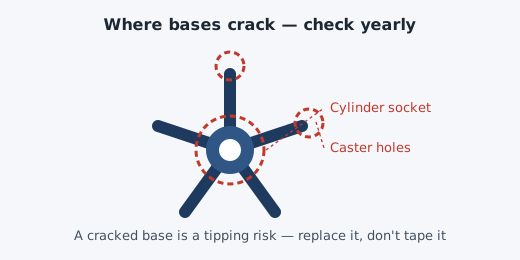
How to inspect an existing chair base
You don't need special equipment to perform a basic visual inspection. Turn the chair carefully enough to see the underside of the base and look for cracks, unusual bends, damaged caster sockets, or anything that has changed since you bought the chair.
Also pay attention to changes you can feel while sitting. A chair that suddenly feels unstable, rocks differently, or makes a new cracking or creaking sound deserves investigation rather than being ignored.
If you find a visible crack in a load-bearing part of the base, don't try to solve the problem with glue, tape, or another temporary repair. Replacing the damaged component is the safer approach.
Can you replace the base instead of the whole chair?
In many cases, yes. Office chair bases are available as replacement parts, which means a damaged base does not necessarily mean the entire chair has reached the end of its useful life.
This can make particular sense when the seat, backrest, mechanism, upholstery, and gas cylinder are still working properly. Replacing one failed structural component may be considerably more sensible than throwing away an otherwise usable chair.
Before ordering a replacement, check the dimensions and compatibility carefully. The centre connection needs to work with the existing gas cylinder, and the caster sockets need to match your casters. Don't assume that every five-star base is interchangeable simply because it looks similar.
If you're also replacing the gas cylinder, our office chair gas cylinder guide explains the role of that component and what to look for.
Base maintenance: what actually matters?
The base itself doesn't require complicated maintenance. A periodic inspection is more useful than a complicated cleaning routine.
Keep the base reasonably clean so you can spot damage, and check the areas around the caster sockets and centre cylinder connection from time to time. If the chair is used heavily, an occasional inspection makes even more sense.
Avoid using the chair outside its intended weight capacity. Also avoid deliberately rocking aggressively, standing on the seat, or using the chair in ways it was not designed for. These behaviours can place loads on the base and frame that are very different from ordinary seated use.
For a broader maintenance routine, see our office chair maintenance checklist.
Don't confuse weight with quality
A heavier base can feel more substantial, but weight alone doesn't prove that a chair is better. Steel is heavier than nylon, for example, but that does not mean every steel base is automatically superior to every reinforced nylon base.
The design, material grade, reinforcement, manufacturing quality, connection points, and stated load rating all contribute to the finished product. When shopping online, look for actual specifications rather than relying on words such as "heavy duty" or "premium."
Why the base is easy to overlook
Manufacturers naturally spend more marketing space on visible features such as lumbar support, mesh, headrests, armrests, and reclining mechanisms. Those are the parts shoppers notice immediately.
The base is different. It sits underneath the chair and doesn't make a product photograph particularly exciting. But it is part of the structure that everything else depends on.
If you're comparing two chairs with similar ergonomics and upholstery, look underneath the marketing. Check the base material, weight capacity, warranty, and availability of replacement parts. Those details can tell you more about long-term ownership than another extra adjustment on the armrest.
When is a metal base worth paying extra for?
A metal base can be worth considering when you want a particularly rigid construction, have a higher body weight, use the chair heavily, or simply prefer the feel and finish of a premium metal base.
It is not necessary to pay for metal just because it sounds stronger. If a reinforced nylon base has an appropriate weight rating, solid construction, good warranty, and reliable replacement support, it may be the more sensible choice for a normal workstation.
In other words, choose the construction that matches your use rather than paying automatically for the most expensive material.
My practical checklist
If I were comparing office chairs, I would keep the base decision simple:
- Prefer a properly constructed five-star base.
- Don't automatically reject reinforced nylon.
- Be cautious about thin, poorly specified plastic bases.
- Check the manufacturer's weight capacity.
- Look for a reasonable warranty.
- Check whether replacement bases and casters are available.
- Inspect the centre socket and caster connections on an existing chair.
- Choose metal when its additional rigidity or durability genuinely matches your requirements.
Conclusion
The base and frame are the structural foundation of an office chair. You don't need the most expensive material to get a dependable chair, but you should avoid treating the base as an afterthought.
Reinforced nylon can provide an excellent balance of strength, weight, and cost for everyday use. Aluminium offers a rigid and premium option, while steel is particularly attractive when maximum rigidity and heavy-duty construction are priorities. Basic plastic can work in some chairs, but thin or poorly reinforced designs deserve more caution.
More importantly, look at the whole chair rather than one specification. Check the base, frame, weight rating, warranty, and availability of replacement parts together. A good office chair is an investment you use for thousands of hours, and a solid foundation is one of the easiest things to overlook until it becomes a problem.